Johns Creek Named First “BioReady Community” in Georgia
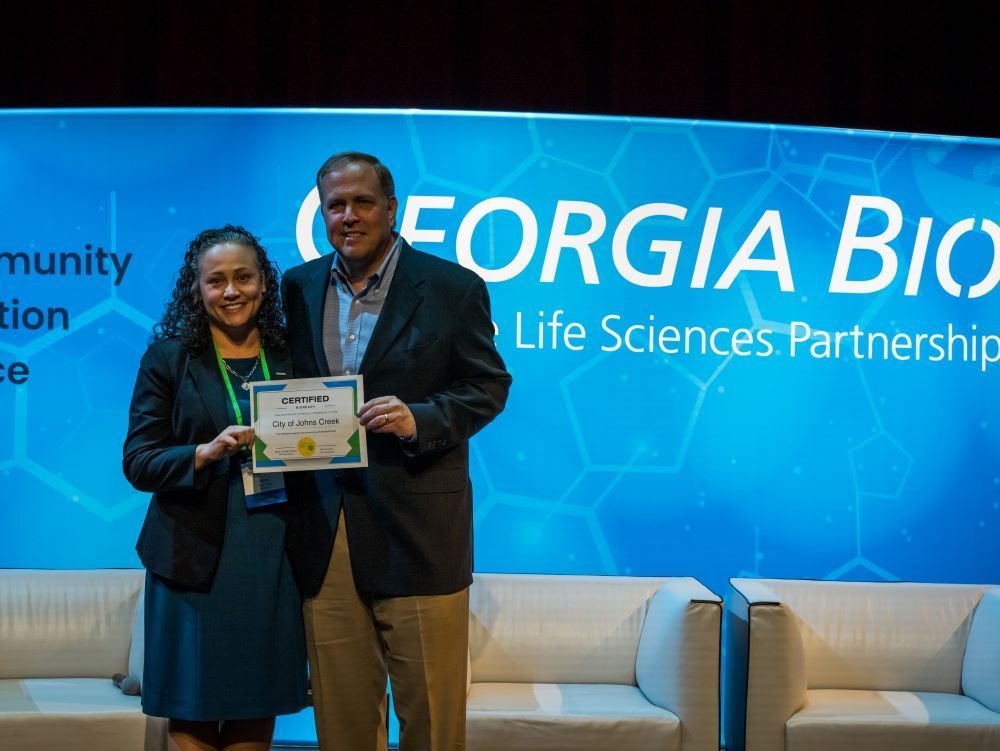
Mainstage at the GA Life Sciences Summit

As the life sciences sector in Georgia continues to grow at a rapid pace, the need for bioready sites grows. As just the second state in the country to formally adopt such a program, the BioReady Community program will allow Georgia’s municipalities to showcase biotech-zoned science parks, streamline permitting, build a robust infrastructure, and identify biotech-friendly sites more effectively in the interest of attracting companies interested in relocating. 

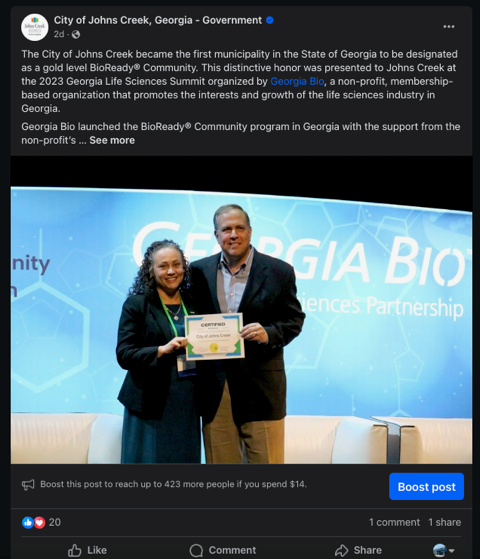
After lunch Maria announced that the City of Johns Creek is the first municipality in the state to achieve this designation.

Mainstage at the GA Life Sciences Summit

Johns Creek Mayor John Bradbury said, “We need to challenge each other. We can push the ball forward at a grassroots level .… And hopefully that’s going to mean a bigger ecosystem for this industry in our state.”

Given the industry’s large footprint in Georgia including 78,000 direct jobs across 4,000 establishments, nearly 215,000 total jobs and over $50 billion in economic impact, Georgia cities and towns are increasingly adopting local policies that greatly ease the pathway for renovation or new construction of biotech laboratory and manufacturing facilities.

Georgia Bio’s counterpart in Massachusetts, MassBio, has developed a rating system to determine a municipality’s readiness to host biotechnology facilities based on the community’s zoning practices and infrastructure capacity. BioReady® rates these communities in three tiers from Bronze to Gold. Through these BioReady® ratings, Georgia Bio seeks to provide cities and towns a platform to effectively tell their stories to the biotechnology industry that will ultimately help real estate developers and biotechnology companies find the most favorable destinations to locate.

AtlantaInno and Atlanta Business Chronicle Reporter Rebecca Grapevine noted, “Earlier this year, Johns Creek tallied a win when Boston Scientific Corp. (NYSE: BSX) committed to a nearly quarter-million-square-foot lease at the former State Farm campus. The expansion could bring up to 340 jobs, the company said.” [Note: subscription required.]

Click Here to View the Georgia BioReady Page & Learn How to Apply

—————————–

Below are Links to the John’s Creek Announcements
Mainstage at the GA Life Sciences Summit
October 5, 2026
Georgia Life Sciences has submitted written comments to the Georgia House Study Committee on Pharmacy Benefits Managers and Consumers’ Access to Prescription Medications, encouraging greater transparency, accountability, and a focus on measurable patient benefit across the prescription drug system. The comments address both pharmacy benefit manager practices and the federal 340B Drug Pricing Program, emphasizing the importance of understanding where prescription drug savings accrue and whether those savings ultimately benefit patients. The Study Committee continues its work this fall as it develops recommendations for the Georgia General Assembly. Read Georgia Life Sciences’ full comments →
September 22, 2026
Georgia Life Sciences (GLS) has joined more than 80 organizations from across industry, academia, public health and the biosecurity community in calling on congressional leaders to fully reauthorize the Pandemic and All-Hazards Preparedness Act (PAHPA) before the end of 2026. Led by the Johns Hopkins Center for Health Security, the coalition urged congressional leaders to advance a comprehensive reauthorization of PAHPA, the federal framework that supports the nation’s ability to prepare for and respond to public health emergencies and other health security threats. First enacted in 2006, PAHPA established and strengthened critical components of the nation’s health security infrastructure, including the Biomedical Advanced Research and Development Authority (BARDA). The law also supports public-private partnerships involved in the research, development, manufacturing and procurement of medical countermeasures, including vaccines, therapeutics and diagnostics. PAHPA’s authorization expired in 2023 and key provisions have since continued through short-term extensions. The coalition is calling for a comprehensive reauthorization that provides greater stability and ensures the nation’s preparedness infrastructure can continue adapting to emerging biological, infectious disease and other health security threats. For the life sciences industry, these programs are particularly important. Partnerships between government and industry can help move promising technologies from research through development and manufacturing while maintaining capabilities needed to respond quickly during an emergency. The Biotechnology Innovation Organization (BIO), also a signatory to the letter, has identified several priorities for reauthorization, including continued authorization of BARDA, the Strategic National Stockpile, Project BioShield and the Pandemic Influenza Program, as well as incentives supporting the development of medical countermeasures. Georgia Life Sciences is proud to join organizations across the country in supporting a strong and sustainable national framework for health security, preparedness and biomedical innovation. Read the coalition letter and view the full list of signatories.
September 14, 2026
Georgia Life Sciences has submitted comments to the Georgia Department of Community Health (DCH) regarding the Georgia Pathways to Coverage program and implementation of new federal Medicaid requirements. As Georgia prepares for these changes, Georgia Life Sciences is urging state leaders to prioritize continuity of care and minimize unnecessary administrative barriers that could delay or disrupt access to medically necessary treatment . This is particularly important for Georgians living with serious, chronic, rare, and medically complex conditions who may rely on ongoing medications, diagnostics, therapies, medical technologies, specialty care, and coordinated treatment plans. Even temporary disruptions in coverage can interrupt care and create additional challenges for patients and families. In its comments, Georgia Life Sciences encouraged DCH to protect continuity of coverage during eligibility and redetermination processes, provide patients and caregivers with clear and timely information, minimize unnecessary administrative burdens, and establish appropriate safeguards when a coverage disruption could interrupt an established course of treatment. “As Georgia implements these new federal requirements, we want to ensure that patients remain at the center of the process,” said Maria Thacker Goethe, MPH, President & CEO of Georgia Life Sciences. “Administrative changes should not become barriers between patients and the care they need. Protecting continuity of care is particularly important for Georgians managing serious and complex health conditions.” Read Georgia Life Sciences’ full comments to DCH here.
MORE POSTS