Micron Biomedical Celebrates the Grand Opening of Its Commercial-Scale Manufacturing Site in Georgia
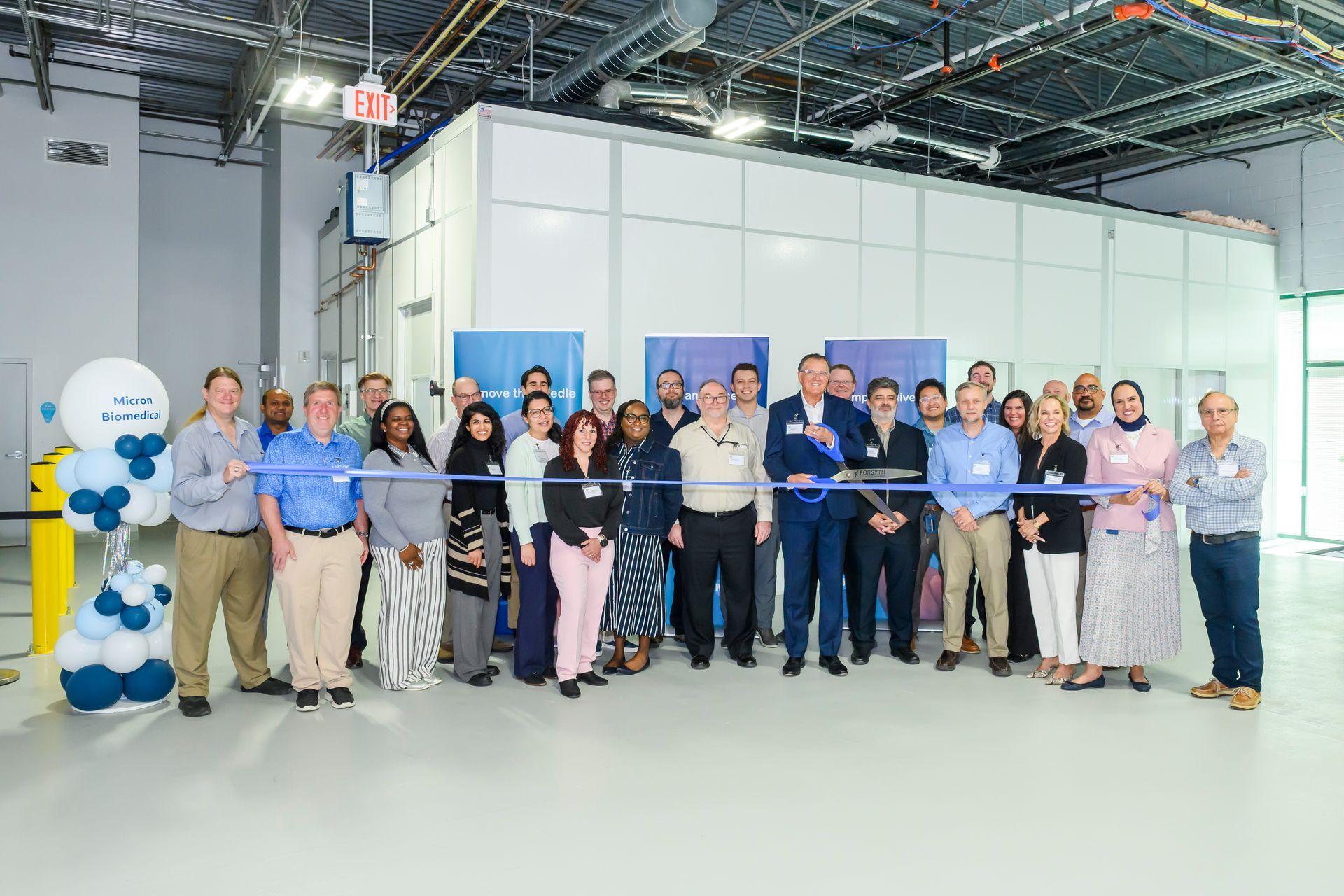
ALPHARETTA, Ga., May 21, 2026 (GLOBE NEWSWIRE) -- Micron Biomedical today announced the grand opening of its world-class manufacturing facility spanning more than 26,000 square feet in Alpharetta, Georgia. The opening marks the most advanced commercial-scale manufacturing site for Micron’s dissolvable vaccine and therapeutic technology in the world and positions the company for pivotal clinical trials that will accelerate the availability of needle-free vaccines and therapeutics that can be self-administered at home.

“A significant body of evidence has shown that our dissolvable microarray technology is as effective as — or more effective than — conventionally injected medicines. Parents, patients, government officials, drug developers, public health leaders, and payers also prefer needle-free vaccines and therapeutics that are simpler and more cost-effective to transport and store,” said Steven Damon, CEO of Micron Biomedical. “Our novel technology requires equally innovative manufacturing equipment capable of scaling production, and this facility brings us one step closer to making that vision a reality.”


Micron’s technology uses a dissolvable microarray “button” that is applied directly to the skin and, when pressed, painlessly delivers medications that dissolve in the uppermost layers of skin. The facility houses all of the equipment and manufacturing capabilities to design and produce Micron’s technology at scale including R&D facilities, wet labs, dry labs, storage and professional office spaces.

Micron Biomedical’s grand opening ceremony was attended by business leaders, elected officials, investors, members of academia and other stakeholders. Representatives from the CDC were also in attendance as recently the CDC launchedits first-ever clinical trial of a needle-free vaccine, evaluating a novel rotavirus vaccine, CC24, delivered via Micron Biomedical’s dissolvable microarray technology. The trial, at Emory University, builds on research, published in The Lancet, about self-administered seasonal influenza vaccine via Micron Biomedical’s dissolvable microarray technology, as well as studies across other disease indications, including measles and rubella.


“Georgia is emerging as one of the country’s most important biotech manufacturing hubs, attracting talented scientists, engineers, business leaders and creating exciting economic and professional opportunities for our residents,” said Todd Jones, Georgia House Representative. “With its award winning first-in-the industry technology, Micron Biomedical is among the state’s leaders in simultaneously transforming the health of people around the world with never-before-possible access to medicine and vaccines - and in investing in the workforce of tomorrow with high paying jobs and growth opportunities."


This year, published research reinforced consumer preference for microarray technology and Micron Biomedical was recognized as the number two most innovative company in its class by Fast Company for addressing global demand for simplified administration and distribution of vaccines and drugs. The scientific community support includes recent commentary in The Lancet which called Micron’s technology “game-changing in humanitarian settings.” Micron’s technology class has also been identified as the highest global priority innovation for overcoming immunization barriers in low- and middle-income countries by the Vaccine Innovation Prioritisation Strategy (VIPS) Alliance. 


“This milestone reflects the type of coordinated ecosystem growth outlined in Georgia Life Sciences’ recently released Roadmap for Georgia’s Life Sciences Sector — bringing together industry, startups, manufacturers, educators, investors, and policymakers to strengthen the state’s innovation and manufacturing capabilities,” said Maria Thacker Goethe, President and CEO of Georgia Life Sciences , who attended the ribbon cutting ceremony. “With this cutting-edge facility, Micron is helping advance Georgia’s position as a national leader in biotechnology, medical technology, and life sciences innovation while reinforcing the state’s role as a scale-up manufacturing hub for the Southeast.”


“Ribbon cuttings are always special and momentous events, but this one is especially satisfying because it points to an infrastructure for pivotal clinical trials of technologies being studied at Emory that have the potential to save lives and reduce disease burden by expanding coverage and access to critical medications,” said Christina Rostad MD, pediatric infectious disease associate professor at Emory University and lead investigator of the CD244 trial who provided commentary remotely. “Our team at Emory University is excited to be a part of the celebration and look forward to continuing to explore the potential of Micron Biomedical’s dissolvable microarray vaccine technology.“


About Micron Biomedical
Micron Biomedical is the leader in dissolvable microarray-based, drug and vaccine administration technology with a growing pipeline of needle-free versions of previously injectable-only medicines. Micron Biomedical is a clinical-stage life science company on a rapid path to commercializing its proprietary dissolvable, microarray technology. Micron’s technology is designed to improve access and achieve better health outcomes globally through injection-free, painless, and simple and/or self-administration of drugs and vaccines, and by eliminating or reducing the need for cold chain transport and storage, enhancing safety and efficacy, and improving patient compliance. Micron partners with and/or receives funding from private and public entities including pharmaceutical and biotech companies, the Gates Foundation, the Centers for Disease Control and Prevention (CDC), PATH and the Georgia Research Alliance. For more information visit
www.micronbiomedical.com.


Press Contact 
Shira Derasmo
M: +1-917-280-2497
E:
pr@micronbiomedical.com


A photo accompanying this announcement is available at
https://www.globenewswire.com/NewsRoom/AttachmentNg/31153de2-caed-4aa2-b291-ebeed2652b70


A video accompanying this announcement is available at
https://www.globenewswire.com/NewsRoom/AttachmentNg/d855a883-fb26-47ce-9831-8ef1e0b93f43
June 18, 2026
June 18, 2026 - Athens Bioscience, Inc., a US manufacturer of native human and animal proteins, today announced a change in leadership. Benjamin Newland, the company’s Executive Chairman, has become Chairman and Chief Executive Officer, effective today. John Mitchell, who has led the company as CEO for five years, will continue as special advisor. Karson Durie rejoins Athens as Chief Operating Officer, effective June 8, 2026. Dee Athwal, a biotechnology executive and antibody engineer, will join the board of directors on July 1, 2026. Newland becomes chief executive four decades after his father, Dr. Hillary Newland, co-founded the company that became Athens Bioscience in 1986 at the University of Georgia. Newland has served as Chairman and majority shareholder since March 2024 and is relocating from Spain to Athens, Georgia, to take the role. “For forty years Athens has made native proteins in-house, lot after lot — proteins that researchers and diagnostics labs build their own work on top of,” said Benjamin Newland, Chairman and CEO of Athens Bioscience. “What we want to do now is deepen relationships with our core customers and broaden our distribution.We also intend to develop our custom and contract manufacturing line of business. John was instrumental in building internal systems and processes and now we are ready to scale.” Mitchell led Athens for five years. As special advisor, he will support the transition and continue to advise on customer and commercial matters. “Athens made great proteins long before I showed up. What it needed was a tighter operation behind them – steadier planning, cleaner production, shipments you can count on,” said John Mitchell. “That’s built now. The next thing is getting Athens in front of more of the world and I look forward to supporting Benjamin as he moves forward with that.” Durie returns to Athens as Chief Operating Officer, having most recently served as Director of Product Development at Danimer Scientific. She previously served as Lab Director at Athens. She holds a PhD in polymer chemistry and an MBA in finance from the University of Georgia and is a Project Management Professional (PMP) and a registered patent agent. “I know this facility and the people in it,” said Karson Durie, Chief Operating Officer of Athens Bioscience. “Returning as COO is a chance to scale what already works — consistent lots, tight quality control, reliable supply — as demand grows across diagnostics and cell culture.” Athwal will join the board on July 1. He trained as a biophysicist and established the antibody engineering group at Celltech, where he is named as an inventor on foundational antibody-engineering patents. He has founded or co-founded five biotechnology companies and held C-level roles across the UK, US, Europe, Asia, and Latin America, including building Complement Therapeutics as CEO and leading the biologics strategy at Kelix Bio through its acquisition by Mubadala. His work in antibodies, immune proteins, and complement biology maps directly to Athens’s largest product lines. About Athens Bioscience  Athens Bioscience, Inc. (formerly Athens Research & Technology) manufactures native human and animal proteins for research, cell culture media, and in vitro diagnostics. Founded in 1985 at the University of Georgia, the company purifies more than 170 native proteins in-house at its ISO 9001:2015-certified facility in Athens, Georgia. Athens proteins have been cited in more than 2,500 peer-reviewed publications and reach customers across the US, Europe, Asia, the Middle East, and Africa. Athens does not resell or broker. It manufactures. Media Contact Christie DeMasi Athens Bioscience, Inc. christie@athensbioscience.com +1.706.546.0207
June 17, 2026
As part of the Georgia Life Sciences Summit (August 25–26), applications are now open for the Startup Showcase , sponsored by Johnson & Johnson , highlighting early-stage innovation across MedTech and Therapeutics . The Showcase will feature some of Georgia’s most innovative life science startups, giving emerging companies the opportunity to present groundbreaking technologies, products, and solutions to a distinguished audience of industry leaders, investors, researchers, and partners. Selected startups will present during the August 26 luncheon program and participate in a live investor Q&A session with John Gutierrez (Ascenta Capital), Emma Heckenberg, Ph.D. (Solas BioVentures), Patrick Jordan (NovaQuest Capital Management), and Emily Dinu (Numinous Capital) Members of the Johnson & Johnson external innovation team will also be onsite for the program and select companies will be scheduled for a 1:1 meeting to discuss strategic alignment and potential collaboration opportunities. If you or companies in your network are building in MedTech or Therapeutics, this is a strong opportunity to gain visibility, receive feedback on commercialization and growth strategy, and connect with key stakeholders. All applicants receive a complimentary Summit registration, and one selected company will also be invited to participate in the NewYorkBIO / New York Stock Exchange Life Sciences Showcase on December 10. If this is relevant to your work, it would be a strong opportunity to consider applying. If not, it may be worth sharing with companies in your network who are building in this space.
June 15, 2026
Workforce & Education Impact: Building Georgia's Future  Life Sciences Workforce - One Teacher at a Time June 16, 2026 - As Georgia Life Sciences concludes the 2025-2026 cycle of the Biotech Teacher Training Initiative (BTTI), the results reinforce the critical role educators play in building the state's future life sciences workforce. Since July of 2025, BTTI engaged 98 educators representing 40 schools across 23 school systems, reaching an estimated 5,375 students through hands-on biotechnology instruction, career-connected learning, and industry-relevant classroom experiences. The Georgia Life Sciences Equipment Depot further expanded the program's impact by supporting 238 teachers with access to laboratory equipment and materials that make authentic life sciences learning possible. Georgia Life Sciences is also pleased to report that funding for BTTI was maintained in the Georgia House version of the FY 2027 budget approved earlier this year. The upcoming 2026-2027 program cycle will mark an important evolution for BTTI. Building on feedback from industry partners and workforce trends across the life sciences sector, Georgia Life Sciences will expand the program's scope to better reflect the skills and competencies employers increasingly need. In addition to foundational biotechnology concepts, future programming will be organized around key industry domains, including Quality Assurance and Quality Control (QA/QC), Research & Development (R&D), MedTech, Artificial Intelligence, Automation, and Advanced Manufacturing. This expanded approach will provide educators with greater insight into the breadth of career opportunities available across Georgia's life sciences ecosystem while helping students develop awareness of the technologies and disciplines shaping the industry's future. The impact extends far beyond individual workshops, creating lasting connections between Georgia classrooms and the state's growing life sciences ecosystem while helping build the talent pipeline that will power Georgia's future innovation economy. "Before BTTI, I was hesitant to do biotech labs because they seemed too complex and expensive," shared Josephine Jeganathan of Stockbridge High School. "The program showed me how simplified it can be and provided the equipment and materials needed to successfully implement the Central Dogma Lab with all my classes." Teachers are also seeing increased student engagement through hands-on learning experiences. Tonie Curry of North Clayton High School used a chromatography lab to connect environmental science concepts to water pollution and sustainability. "Students were highly interested in seeing how substances separated and made strong connections to water pollution and environmental sustainability," Curry noted. "The hands-on nature of the lab encouraged curiosity and deeper understanding." For many educators, one of the most valuable aspects of the program is the connection between classroom learning and real-world careers. As Marshai Waiters of Marietta Middle School reflected: "Exposure is key. There are so many avenues to work in STEM, and they are all accessible with opportunity and knowledge. The insights gained from industry speakers will inform my teaching and create new opportunities for student exposure." When teachers are trained, equipped, and connected to industry, students gain more than a science lesson—they gain a window into Georgia's life sciences future.
MORE POSTS