Georgia Life Sciences Announces 2026 Golden Helix Award Honorees

Award recipients will be recognized at the Golden Helix Awards Ceremony on August 25


ATLANTA, Ga. – Georgia Life Sciences today announced the recipients of the 2026 Golden Helix Awards, recognizing the individuals, organizations, partnerships, and investments that are advancing innovation, improving patient care, strengthening Georgia's economy, and shaping the future of the state's life sciences ecosystem.


The honorees will be celebrated during the Georgia Life Sciences Summit Welcome Reception and Golden Helix Awards Ceremony on Tuesday, August 25, at the Sandy Springs Performing Arts Center, kicking off Georgia's premier gathering of life sciences leaders ahead of the Summit on Wednesday, August 26.


"For nearly two decades, the Golden Helix Awards have celebrated the people and organizations whose vision, collaboration, and commitment continue to elevate Georgia as a global leader in life sciences," said Maria Thacker Goethe, President & CEO of Georgia Life Sciences. "This year's recipients represent the extraordinary innovation taking place across our state—from groundbreaking research and transformative investments to workforce development and community impact. We are proud to recognize their achievements and the lasting difference they are making for patients, our economy, and the future of healthcare."


2026 Golden Helix Award Honorees


Phoenix Award

· Micron Biomedical, Emory University, and CDC – Industry-Academic Partnership


Innovation Awards

· Dr. Kyle Johnsen, University of Georgia

· Focused Cryo


Community Awards

· Angela Gill Nelms, Biolocity

· Frugal Science Academy

· Jessica King Holden, Gwinnett Regional Science, Engineering + Innovation Fair

· Dr. Marlo Vernon, Augusta University


Deal of the Year Awards


Economic Development

· UCB

· Shriners Children's Research Institute and Georgia Tech


Acquisition

· LymphaTech & Tactile Medical

· Avanos Medical


Financing

· Altesa BioSciences


Federal Grant

· HEAL: Healthy Ameliorated Lymphatics, Georgia Institute of Technology

· Manus & U.S. Department of Health and Human Services Administration for Strategic Preparedness and Response (HHS/ASPR)


Emerging Leader of the Year

· Dr. Ryan Devine, Medical Innovation Hub, Georgia Tech


Legislator of the Year

· Rep. Matt Dubnik (R-29)


Teacher of the Year

· Ana White, DeKalb High School of Technology North at Cross Keys


The Golden Helix Awards recognize excellence across Georgia's life sciences ecosystem, honoring breakthrough scientific discoveries, strategic partnerships, commercial achievements, community leadership, and investments that strengthen the state's position as a national leader in biotechnology, medical technology, pharmaceuticals, research, and advanced manufacturing.


The awards ceremony serves as the opening event of the 2026 Georgia Life Sciences Summit, bringing together executives, researchers, entrepreneurs, investors, and healthcare leaders, and academic institutions from across the state to celebrate innovation and explore opportunities shaping the future of Georgia's life sciences industry.


The Georgia Life Sciences Summit will take place on Wednesday, August 26, at the Sandy Springs Performing Arts Center, featuring nationally recognized speakers, executive panels, CEO spotlights, networking opportunities, and the Solutions Corridor showcasing organizations driving the industry's continued growth.


To learn more about the Georgia Life Sciences Summit or to register, visit https://www.galifesciences.org/summit.
September 22, 2026
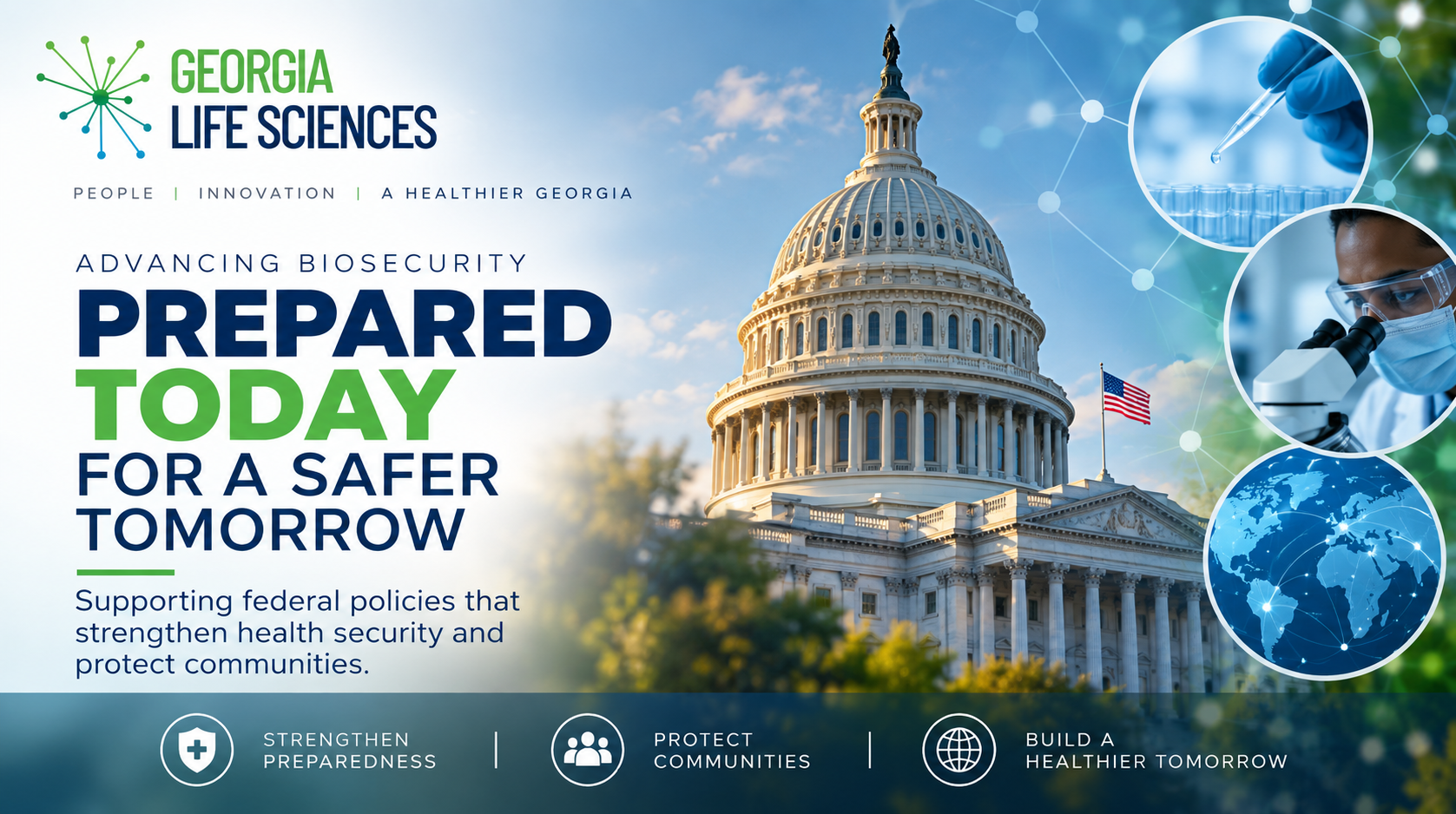
Georgia Life Sciences (GLS) has joined more than 80 organizations from across industry, academia, public health and the biosecurity community in calling on congressional leaders to fully reauthorize the Pandemic and All-Hazards Preparedness Act (PAHPA) before the end of 2026. Led by the Johns Hopkins Center for Health Security, the coalition urged congressional leaders to advance a comprehensive reauthorization of PAHPA, the federal framework that supports the nation’s ability to prepare for and respond to public health emergencies and other health security threats. First enacted in 2006, PAHPA established and strengthened critical components of the nation’s health security infrastructure, including the Biomedical Advanced Research and Development Authority (BARDA). The law also supports public-private partnerships involved in the research, development, manufacturing and procurement of medical countermeasures, including vaccines, therapeutics and diagnostics. PAHPA’s authorization expired in 2023 and key provisions have since continued through short-term extensions. The coalition is calling for a comprehensive reauthorization that provides greater stability and ensures the nation’s preparedness infrastructure can continue adapting to emerging biological, infectious disease and other health security threats. For the life sciences industry, these programs are particularly important. Partnerships between government and industry can help move promising technologies from research through development and manufacturing while maintaining capabilities needed to respond quickly during an emergency. The Biotechnology Innovation Organization (BIO), also a signatory to the letter, has identified several priorities for reauthorization, including continued authorization of BARDA, the Strategic National Stockpile, Project BioShield and the Pandemic Influenza Program, as well as incentives supporting the development of medical countermeasures. Georgia Life Sciences is proud to join organizations across the country in supporting a strong and sustainable national framework for health security, preparedness and biomedical innovation. Read the coalition letter and view the full list of signatories.
September 14, 2026
Georgia Life Sciences has submitted comments to the Georgia Department of Community Health (DCH) regarding the Georgia Pathways to Coverage program and implementation of new federal Medicaid requirements. As Georgia prepares for these changes, Georgia Life Sciences is urging state leaders to prioritize continuity of care and minimize unnecessary administrative barriers that could delay or disrupt access to medically necessary treatment . This is particularly important for Georgians living with serious, chronic, rare, and medically complex conditions who may rely on ongoing medications, diagnostics, therapies, medical technologies, specialty care, and coordinated treatment plans. Even temporary disruptions in coverage can interrupt care and create additional challenges for patients and families. In its comments, Georgia Life Sciences encouraged DCH to protect continuity of coverage during eligibility and redetermination processes, provide patients and caregivers with clear and timely information, minimize unnecessary administrative burdens, and establish appropriate safeguards when a coverage disruption could interrupt an established course of treatment. “As Georgia implements these new federal requirements, we want to ensure that patients remain at the center of the process,” said Maria Thacker Goethe, MPH, President & CEO of Georgia Life Sciences. “Administrative changes should not become barriers between patients and the care they need. Protecting continuity of care is particularly important for Georgians managing serious and complex health conditions.” Read Georgia Life Sciences’ full comments to DCH here.
August 31, 2026
The White House, August 31, 2026 - ADVANCING MOST-FAVORED-NATION (MFN) PRICING: Today, President Donald J. Trump announced nine new agreements with pharmaceutical manufacturers to lower prescription drug prices for Americans in line with the lowest prices paid by other developed nations (known as the most-favored-nation, or MFN, price). The agreements bring the total number of pharmaceutical manufacturers with MFN deals to 26, covering 89% of the branded drug market. The nine manufacturers are comprised of mid-sized pharmaceutical companies, including Alcon, Astellas Pharma, BeOne Medicines, BridgeBio, CSL, Kyowa Kirin, Sun Pharma, Teva Pharmaceuticals, and UCB. The agreements reduce prices on drugs that treat numerous costly, chronic, and even rare diseases, including hemophilia, Parkinson’s disease, macular degeneration, glaucoma, liver disease, skin conditions, and various forms of cancer. The agreements will provide every State Medicaid program in the country access to MFN drug prices on products made by the nine companies, resulting in billions of dollars in savings for Americans and continuing President Trump’s historic efforts to strengthen the program for the most vulnerable. The agreements ensure foreign nations can no longer use price controls to freeride on American innovation by guaranteeing MFN prices on all new innovative medicines the nine companies bring to market. Each of these manufacturers has agreed to fundamentally rebalance international drug pricing by providing MFN pricing to American patients. BOLSTERING AMERICA’S PHARMACEUTICAL SUPPLY CHAINS AND RESERVES: These nine pharmaceutical manufacturers committed to invest at least $19.6 billion collectively in U.S. manufacturing in the near term. Additionally, as part of the MFN agreements, several companies are donating active pharmaceutical ingredients for key products to the Strategic Active Pharmaceutical Ingredients Reserve (SAPIR) to reduce reliance on foreign nations and ensure the United States has an adequate supply of such products in the event of an emergency. UCB will contribute 163 tons of levetiracetam, an anticonvulsant used to control and prevent certain types of seizures, to the SAPIR. Sun Pharma will contribute 71.4 tons of clindamycin and 6.75 tons of doxycycline; both antibiotics to treat bacterial infections, to the SAPIR. Teva Pharmaceuticals will contribute 45 metric tons of metronidazole, an antibiotic and antiprotozoal used to treat certain bacterial and parasitic infections, and 4.8 tons of amlodipine, an antihypertensive drug, to the SAPIR. Astellas will contribute 25 kg of tacrolimus, an immunosuppressant used to prevent organ rejection in people who have had organ transplants, to the SAPIR. LOWERING COSTS FOR AMERICANS: President Trump’s decisive and historic actions are lowering drug prices for the American people. Since its February launch, patients have saved more than $700 million on medicines through TrumpRx, including massive discounts on some of the most popular and costly medications used to treat obesity and infertility. In July of 2026, senior citizens without access to GLP-1 coverage to treat obesity gained access for just $50 per month. In the two months since the launch of this program, over 500,000 seniors have saved a total of $216 million dollars on these life-changing medicines. The Council of Economic Advisers estimates the total savings from President Trump’s MFN deals to reach $600 billion over the next decade. DELIVERING ON PROMISES TO PUT AMERICAN PATIENTS FIRST: President Trump is delivering on promises for American patients, accomplishing historic wins that the political establishment did not believe were possible. On May 12, 2025, President Trump signed an Executive Order titled: “Delivering Most-Favored-Nation Prescription Drug Pricing to American Patients” directing the Administration to take numerous actions to bring American drug prices in line with those paid by similar nations. On July 31, 2025, President Trump sent letters to 17 of the leading pharmaceutical manufacturers outlining the steps they must take to bring down the prices of prescription drugs in the United States to match the lowest price offered in other developed nations. There are now MFN deals with each of those leading pharmaceutical manufacturers. On September 30, 2025, President Trump announced the first agreement, with the drug manufacturer Pfizer, to bring MFN prices to American patients. On December 1, 2025, the Office of the United States Trade Representative, the Department of Commerce, and the Department of Health and Human Services announced an agreement with the United Kingdom (U.K.) that will increase the net price of new prescription drugs by 25% in the U.K., helping ensure they pay their fair share for innovative medicines. On December 19, 2025, President Trump announced nine new agreements with major pharmaceutical companies. On February 5, 2026, President Trump launched TrumpRx.gov , where patients can access large discounts on many of the most popular and highest-priced medicines in the country, paying prices in line with the MFN price. As of today, August 31, the Administration now has agreements with Pfizer, Astra Zeneca, EMD Serono, Eli Lilly, Novo Nordisk, Amgen, Bristol Myers Squibb, Boehringer Ingelheim, Genentech, Gilead Sciences, GSK, Merck, Novartis, Sanofi, Johnson & Johnson, AbbVie, Regeneron, Alcon, Astellas Pharma, BeOne Medicines, BridgeBio, CSL, Kyowa Kirin, Sun Pharma, Teva Pharmaceuticals, and UCB. President Trump is calling on Congress to enact the Great Healthcare Plan , a comprehensive plan to lower drug prices, lower insurance premiums, hold big insurance companies accountable, and maximize price transparency. Source: Fact Sheet: President Donald J. Trump Announces Deal with Nine Additional Pharmaceutical Manufacturers to Lower Drug Prices for Americans – The White House
MORE POSTS