Lawmakers Question Kennedy on Vaccines, Biosecurity, and NIH Cuts
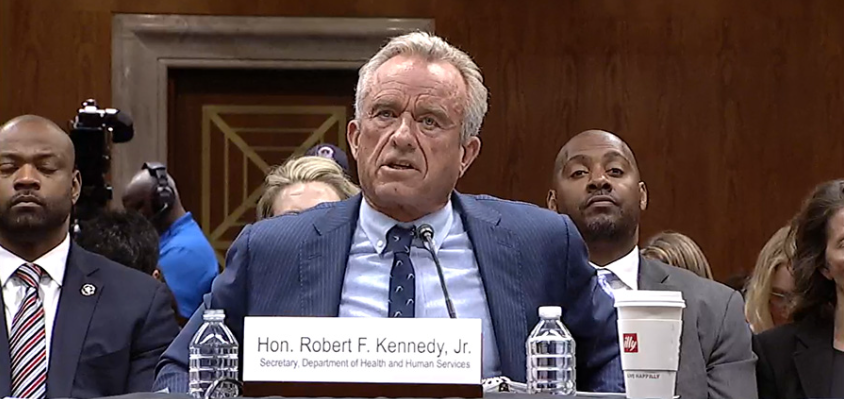
Lawmakers questioned Health and Human Services (HHS) Secretary Robert F. Kennedy Jr. on key issues like vaccines, biosecurity, and federal research funds in a week of congressional hearings about the HHS budget for 2026.
Kennedy was the sole witness at a May 20 hearing of the Senate Appropriations Subcommittee on Labor, Health and Human Services, Education, and Related Agencies, and two May 14 hearings—before the Senate Health Education, Labor and Pensions (HELP) Committee and the House Appropriations Subcommittee on Labor, Health and Human Services, Education, and Related Agencies.
Kennedy found himself on defense over his positions on vaccines and cuts to National Institutes of Health (NIH) funding. On the subject of China and biosecurity, he urged reshoring of manufacturing, noting Eli Lilly’s efforts in this area.
Vaccines and measles
Many questions on vaccines focused on concerns that Kennedy has not done enough to encourage vaccination in the face of ongoing measles outbreaks.
During the House Appropriations hearing, Kennedy responded to a question from Rep. Mark Pocan (D-WI) about his confidence in measles vaccines, saying he would “probably” choose to vaccinate his children against measles again.
“I don’t think people should be taking medical advice from me,” Kennedy added, saying they should get this advice from NIH Director Dr. Jay Bhattacharya.
At the Senate HELP hearing, Democrats raised alarm over Kennedy’s stance on measles vaccines, arguing his statements eroded public trust and contradicted his confirmation hearing testimony.
Ranking Member Bernie Sanders (I-VT) alleged that Kennedy undermined confidence in vaccines during a major measles outbreak. Sen. Maggie Hassan (D-NH) raised similar concerns. Sen. Chris Murphy (D-CT) said Kennedy’s hesitance to unequivocally endorse measles vaccines is “really dangerous for the American public and for families.”
A few days later in the Senate Appropriations subcommittee hearing, Kennedy gave a direct endorsement for the measles, mumps, and rubella (MMR) vaccine.
“The best way to prevent the spread of measles is through vaccination. We urge people to get their MMR vaccines,” he said.
But he added that he understood why some are hesitant.
“There are groups in this country that don’t want to get vaccinated, many of them for religious reasons. I spend a lot of time with the Mennonites. The MMR vaccine has millions of fragments of human DNA in it from aborted fetal tissues and that’s a religious objection for them that I have to respect,” Kennedy said.
As experts have noted, there is no human DNA in MMR vaccines. The attenuated viruses in the rubella component of the vaccine are produced using a cell line obtained from the lung tissue of a single fetus in the 1960s. But those regenerated cells are only used to grow the rubella viruses, and the viruses made in this manner do not contain DNA from the human cells.
Vaccines and placebo testing
Other vaccine-related questions focused on Kennedy’s views about using placebos for vaccine testing.
Under a new framework announced May 20, the Food and Drug Administration (FDA) is expected to require placebo testing for annual COVID boosters in some circumstances. During the hearings, Kennedy promoted the idea of using placebos to test vaccines. Critics of this position note the ethical problem of denying clinical trial participants protection afforded by a vaccine if they receive a placebo.
“The only vaccine that has been tested in a full-blown placebo trial against an inert placebo was the COVID vaccine,” Kennedy told the HELP Committee.
HELP Committee Chair Bill Cassidy, MD (R-LA) corrected this comment.
“The secretary made the statement that no vaccines except for COVID have been evaluated against placebo. For the record that’s not true,” Sen. Cassidy told the hearing. “The rotavirus, measles and HPV vaccines have been, and some vaccines are tested against previous versions, so just for the record, to set that straight.”
In the Senate Appropriations subcommittee hearing the following week, Kennedy was asked by Sen. Brian Schatz (D-HI) if he believed vaccines that are already approved need to be retested using placebo trials.
“I don’t think it’s ethical to go back and retest those vaccines with a placebo,” Kennedy said. “The Cochrane Collaboration in 2016 published a study that showed that the predictive capacity of placebo control trials, which are the gold standard, is actually not any better than good observational trials and retrospective trials. So we can do those kinds of studies without subjecting people to an unethical experiment.”
NSCEB and biosecurity
Kennedy was also asked to address the findings of the recently released report by the Congressional National Security Commission on Emerging Biotechnology (NSCEB).
Created by Congress in the 2022 defense budget, the NSCEB in April released its report warning that China’s strategic spending on biotech R&D increased 400-fold in the last decade as they seek to eclipse U.S. dominance in the field. If the U.S. falls behind, it has serious implications for our national security and health, the report warned.
In the House Appropriations subcommittee, Rep. John Moolenaar (R-MI) mentioned the report and asked whether Kennedy saw overreliance on China for biotech as a threat. Kennedy responded that China is stealing U.S. IP and technology and claimed NIH has enabled this IP theft.
Kennedy said it is important to bring drug production home to the U.S. and noted drug makers are beginning to do that.
“I’ve met repeatedly with Eli Lilly, which is now building nine facilities, nine factories, in this country, including for essential medicines (and) the essential ingredients for those medicines.”
In the Senate HELP hearing later that day, Sen. Jim Banks (R-IN) asked for an update on efforts to reshore drug manufacturing from China to the U.S. Kennedy again mentioned Eli Lilly’s efforts to build production facilities in the U.S. and said movement toward reshoring has been encouraged by President Trump’s threats of tariffs on pharmaceutical companies.
Concerns about NIH funding
There was clear concern about the impact that budget cuts to the NIH would have on biomedical research and the innovation that brings us new drugs.
Lawmakers in all three hearings pushed back on Kennedy’s claims that the NIH is beset by corruption, that NIH cuts are focused on DEI programs rather than research, and that AI will enable the same number of clinical trials to continue despite cutbacks.
In the Senate HELP committee, Chair Cassidy warned that NIH budget reductions would impair capacity for crucial research on neurodegenerative diseases, hinder the development of new scientists, and undermine U.S. competitiveness with China.
Sen. Patty Murray (D-WA) detailed a constituent’s delayed stage-four cancer treatment at the NIH Clinical Center due to staff firings and demanded that Kennedy supply information on specific number of staff cuts. Kennedy acknowledged NIH staff cuts would “hurt” but called them necessary.
Sen. Susan Collins (R-ME) criticized the NIH’s proposed 15% cap on indirect research costs, calling it arbitrary, harmful to research, and likely to drive scientists abroad. She asked if Secretary Kennedy was evaluating its impact on laboratories. Kennedy said a review was underway.
Voicing a similar sentiment In the House Appropriations Committee, Ranking Member Rosa DeLauro (D-CT) said China and Europe are taking advantage of the firings of nearly 5,000 employees at NIH by recruiting American scientists.
As she opened the Senate Appropriations subcommittee hearing, Subcommittee Chair Shelley Moore Capito (R-WVA) underlined the importance of the NIH. “NIH-funded basic research is also behind many of the 600+ new cancer treatments the FDA has approved over the last 20 years,” and other important breakthroughs, Capito said.
‘I am concerned that our country is falling behind in biomedical research,” she added. “Investing in biomedical research has proven to save lives while exponentially strengthening the U.S. economy.”
Author: Tom Popper is the Managing Editor of Bio.News.