
Danish manufacturing firm breaks ground in Peachtree City; 200 new jobs expected

By The Citizen-August 22, 2023

Meditec groundbreaking in Georgia

SP Meditec recently broke ground on a 120,000 square foot, state-of-the-art manufacturing facility that is expected to create 200 new jobs in Peachtree City.

The plant, which will be located off Georgia State Route 74, is scheduled to begin operations in August 2024.

Several factors played into SP Meditec’s selection of Peachtree City for their company’s US expansion. Peter Fejfer, Managing Director for the Denmark-based business, cited the south metro Atlanta community’s proximity to the world’s busiest airport, skilled workforce, and strategic location as reasons behind the decision.

“We aim to tap into Peachtree City’s talented pool of professionals and contribute to the local economy,” Fejfer stated.

SP Meditec develops, manufactures, and assembles plastic solutions for the healthcare industry. Their Peachtree City expansion marks a significant milestone in the company’s strategy and commitment to meeting the growing demand for high-quality injection molded parts worldwide.

“I’m excited to welcome SP Meditec to Peachtree City,” Mayor Kim Learnard said. “This major investment in our city not only underscores our dedication to fostering smart growth and innovation, but also solidifies Peachtree City’s position as a hub for cutting-edge advancements in the healthcare sector.”

Dividend Realty is acting as project developer for the new plant. Their subsidiary, Dividend ECS, will design the facility. Davis Construction will serve as the facility’s construction manager.

“We look forward to completing the project and are committed to continuing our growth in this new market,” Fejfer continued.

October 5, 2026
Georgia Life Sciences has submitted written comments to the Georgia House Study Committee on Pharmacy Benefits Managers and Consumers’ Access to Prescription Medications, encouraging greater transparency, accountability, and a focus on measurable patient benefit across the prescription drug system. The comments address both pharmacy benefit manager practices and the federal 340B Drug Pricing Program, emphasizing the importance of understanding where prescription drug savings accrue and whether those savings ultimately benefit patients. The Study Committee continues its work this fall as it develops recommendations for the Georgia General Assembly. Read Georgia Life Sciences’ full comments →
September 22, 2026
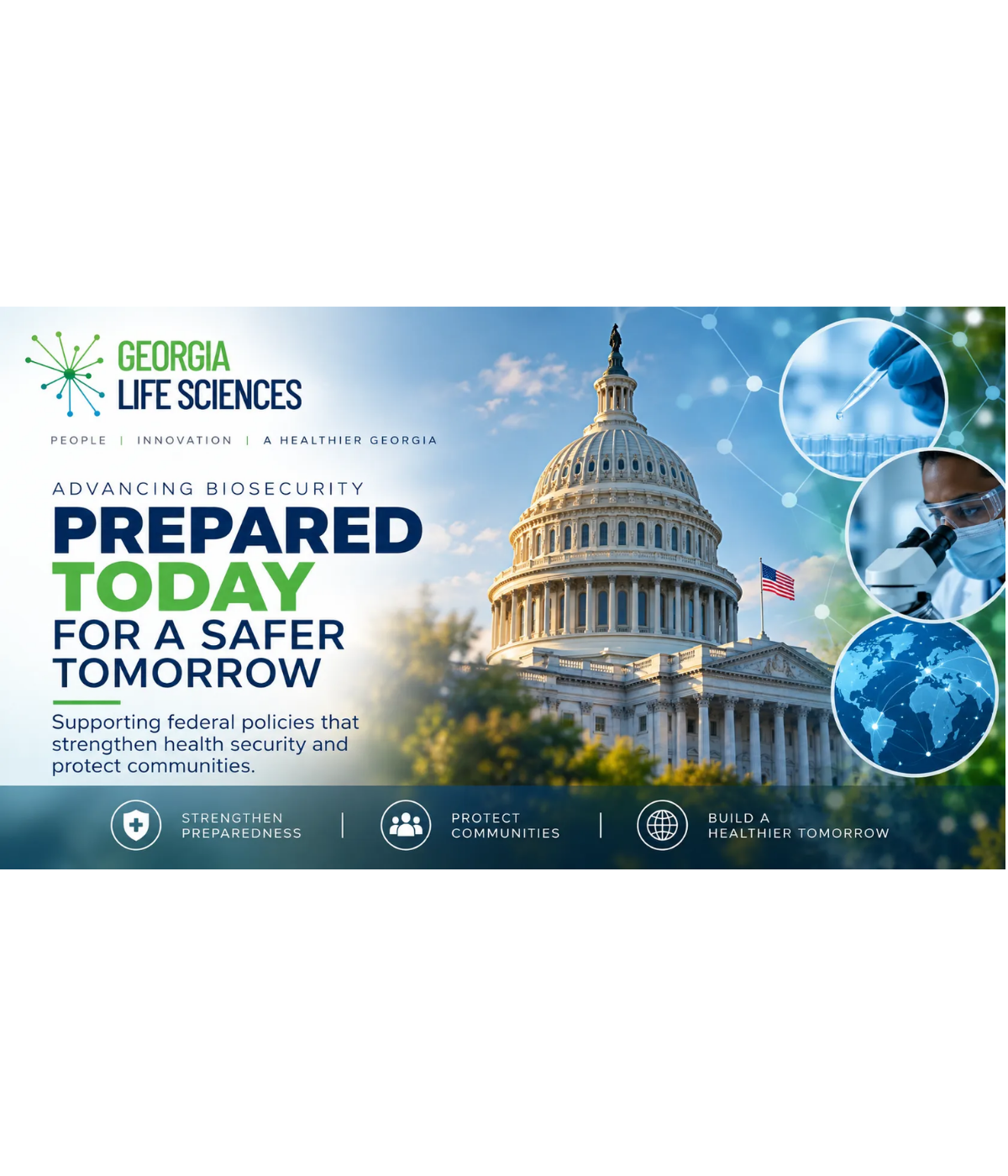
Georgia Life Sciences (GLS) has joined more than 80 organizations from across industry, academia, public health and the biosecurity community in calling on congressional leaders to fully reauthorize the Pandemic and All-Hazards Preparedness Act (PAHPA) before the end of 2026. Led by the Johns Hopkins Center for Health Security, the coalition urged congressional leaders to advance a comprehensive reauthorization of PAHPA, the federal framework that supports the nation’s ability to prepare for and respond to public health emergencies and other health security threats. First enacted in 2006, PAHPA established and strengthened critical components of the nation’s health security infrastructure, including the Biomedical Advanced Research and Development Authority (BARDA). The law also supports public-private partnerships involved in the research, development, manufacturing and procurement of medical countermeasures, including vaccines, therapeutics and diagnostics. PAHPA’s authorization expired in 2023 and key provisions have since continued through short-term extensions. The coalition is calling for a comprehensive reauthorization that provides greater stability and ensures the nation’s preparedness infrastructure can continue adapting to emerging biological, infectious disease and other health security threats. For the life sciences industry, these programs are particularly important. Partnerships between government and industry can help move promising technologies from research through development and manufacturing while maintaining capabilities needed to respond quickly during an emergency. The Biotechnology Innovation Organization (BIO), also a signatory to the letter, has identified several priorities for reauthorization, including continued authorization of BARDA, the Strategic National Stockpile, Project BioShield and the Pandemic Influenza Program, as well as incentives supporting the development of medical countermeasures. Georgia Life Sciences is proud to join organizations across the country in supporting a strong and sustainable national framework for health security, preparedness and biomedical innovation. Read the coalition letter and view the full list of signatories.
September 14, 2026
Georgia Life Sciences has submitted comments to the Georgia Department of Community Health (DCH) regarding the Georgia Pathways to Coverage program and implementation of new federal Medicaid requirements. As Georgia prepares for these changes, Georgia Life Sciences is urging state leaders to prioritize continuity of care and minimize unnecessary administrative barriers that could delay or disrupt access to medically necessary treatment . This is particularly important for Georgians living with serious, chronic, rare, and medically complex conditions who may rely on ongoing medications, diagnostics, therapies, medical technologies, specialty care, and coordinated treatment plans. Even temporary disruptions in coverage can interrupt care and create additional challenges for patients and families. In its comments, Georgia Life Sciences encouraged DCH to protect continuity of coverage during eligibility and redetermination processes, provide patients and caregivers with clear and timely information, minimize unnecessary administrative burdens, and establish appropriate safeguards when a coverage disruption could interrupt an established course of treatment. “As Georgia implements these new federal requirements, we want to ensure that patients remain at the center of the process,” said Maria Thacker Goethe, MPH, President & CEO of Georgia Life Sciences. “Administrative changes should not become barriers between patients and the care they need. Protecting continuity of care is particularly important for Georgians managing serious and complex health conditions.” Read Georgia Life Sciences’ full comments to DCH here.
MORE POSTS