
Report: Americans' Opinions on Bioindustrial Manufacturing

BioMADE Releases New National Survey Showing Strong, Bipartisan Support for U.S. Leadership in Bioindustrial Manufacturing

Survey finds that the majority of Americans want more bio-based products, increased federal investment,

and strategic action to stay ahead of global competitors.


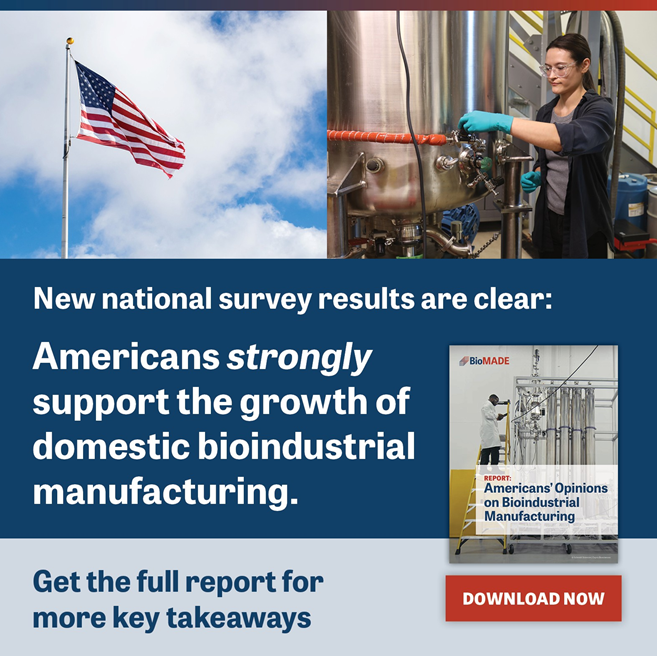
MINNEAPOLIS-ST. PAUL, MN/EMERYVILLE, CA, July 13, 2026 – Today, BioMADE released the results of a new national survey finding broad, bipartisan support for expanding America’s bioindustrial manufacturing capabilities. The results show that Americans across regions, demographics, and political affiliations overwhelmingly want more bio-based products in the supply chain, believe the federal government should invest in domestic biomanufacturing, and want the U.S. to fight to be a global leader in this competitive industry. 

Fifty-six percent of Americans say they want more American-made, bio-based products available on store shelves and in the supply chain, while only five percent disagree. Six in ten believe that the U.S. Government should invest in biomanufacturing research and production to reduce reliance on foreign supply chains and strengthen national competitiveness. Again, only five percent disagreed. Fifty-nine percent also say that the U.S. must fight to remain a global leader and avoid falling behind China, India, and the E.U. in biomanufacturing. 


“The results of this survey confirm what we are seeing and hearing across the country: bioindustrial manufacturing has the power to create jobs people want, support domestic supply chains, and reduce U.S. reliance on foreign imports. We are seeing massive global investments by governments across the globe including India, China, and across Europe. The majority of Americans aren’t only open to federal investment to win this critical industry, they are expecting it,” said Douglas Friedman, Chief Executive Officer at BioMADE.


Currently, China invests at least $4.3 billion annually in biomanufacturing and plans to build 20 pilot-scale plants by 2027. India is constructing over 20 new facilities and aims to double the economic impact of its biomanufacturing sector by 2030. And, the E.U. already has at least twice the fermentation capacity of the U.S. The majority of Americans recognize this gap and the urgency of closing it. Without quick and strategic action, the U.S. risks permanently losing its competitive advantage. 


Conducted in partnership with YouGov, the survey highlights a clear message: Americans want bio-based products, support government investment in biomanufacturing, and want to be a global leader in this industry. As the U.S. continues to build momentum in this industry, BioMADE remains committed to strengthening global competitiveness, advancing innovation, and ensuring the U.S. leads in this sector.


Download The Full Report
August 21, 2026
Genetic Engineering & Biotechnology News (GEN) has named Georgia #4 among its “Next 5 States” for emerging U.S. biopharma clusters . The article highlights UCB’s planned $2 billion investment at in Gwinnett County, Micron Biomedical’s new Alpharetta facility, Manus Bio’s expansion in Augusta, Science Square, Emory University, the CDC — and Georgia Life Sciences’ 10-year Life Sciences Roadmap . This recognition is exciting. But even more importantly, it validates the work happening across our entire ecosystem — and perfect momentum as we head into the 2026 Georgia Life Sciences Summit next week. Read more by visiting: Next 10 U.S. Biopharma Clusters
August 17, 2026
Biotechnology Innovation Organization (BIO) Senior Vice President of Science & Regulatory Affairs Annetta Beauregard issued the following statement on the release of the Prescription Drug User Fee Act (PDUFA) VIII commitment letter: “For more than 30 years, PDUFA has helped deliver hundreds of new medicines to American patients. As a lead industry negotiator for the PDUFA VIII agreement, BIO supports the PDUFA VIII commitment letter and its strengthening of regulatory review, advancing innovation, and helping deliver safe and effective treatments to patients. “Specifically, the PDUFA VIII agreement includes important commitments that bolster the FDA’s core review activities, ensure accountability for predictable performance, improve financial sustainability and improve communication, transparency and efficiency. “Timely, bipartisan reauthorization of PDUFA is vital for protecting the health of Americans, strengthening U.S. competitiveness, and maintaining America’s global leadership in medical innovation. BIO is committed to working with Congress to ensure reauthorization by September 30, 2027.” The FDA has announced plans to hold a hybrid public meeting at 9am on 9/16 to discuss the proposed enhancements for the reauthorization of PDUFA for fiscal years (FYs) 2028 through 2033. Learn More about PDUFA and the PDUFA VIII commitment letter HERE .
August 17, 2026
Representing Georgia’s life sciences community, GLS emphasized the importance of advancing policies that improve affordability and patient access while preserving the environment necessary for continued biomedical innovation. In its comments, GLS urged CMS to maintain a framework grounded in FDA regulatory determinations and raised concerns about how certain proposed policies could affect post-approval research and development, investment in new indications, and patient access to innovative therapies. GLS also encouraged CMS to consider the broader implications for healthcare delivery, including the potential impact on patients and providers in rural and underserved communities. As federal drug pricing policy continues to evolve, Georgia Life Sciences will continue to advocate for approaches that balance affordability, access, and innovation while ensuring Georgia’s life sciences community has a voice in the policymaking process. Read Georgia Life Sciences’ full comments to CMS ( click here ).
MORE POSTS