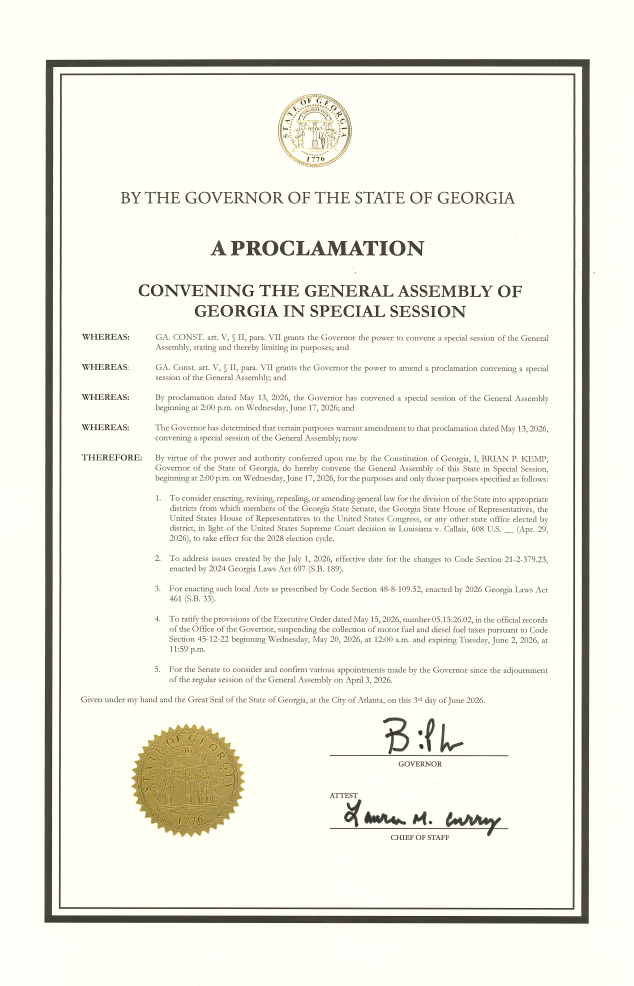
Governor Kemp Calls Special Session
June 4, 2026 - Governor Brian Kemp has issued a formal proclamation convening the Georgia General Assembly in a special session, signaling the need for legislative action outside the regular session calendar. Under the Georgia Constitution, the Governor is empowered to call a special session and define the scope of issues lawmakers may consider. In this instance, the proclamation outlines the specific subject matter to be addressed, effectively limiting legislative activity to those enumerated items.
The proclamation underscores the urgency and importance the administration places on the identified issues, which may include time-sensitive fiscal matters, policy priorities, or emergent statewide concerns that cannot reasonably wait until the next regular session. By setting the agenda, the Governor not only accelerates legislative consideration but also shapes the policy framework within which the General Assembly must operate.
From a practical standpoint, the special session compresses the legislative timeline, requiring stakeholders to quickly mobilize, engage decision-makers, and adapt strategies in a fast-moving environment. For clients and partners, this means heightened attention to committee activity, leadership negotiations, and potential amendments, as outcomes are often determined on an expedited basis.
Topspin Strategies will continue to monitor developments closely, provide real-time updates, and engage with key policymakers to ensure our clients’ priorities are effectively represented throughout the duration of the special session.
Details About the Code Sections Being Discussed:
Code Section 21-2-379.23
This law applies to Georgia’s electronic ballot marking devices.
Key requirements:
- Ballots must include standard info like:
- “OFFICIAL BALLOT”
- Election date
- Candidates, offices, and questions
- Ballots must be printed on secure paper with features like a watermark.
The text on the paper ballot is the official vote
- The
human-readable text (what you can read on the ballot)
= the legally binding vote - This applies to:
- Vote tabulation
- Recounts
- Audits
What S.B. 189 changed
The 2024 law (Act 697 / S.B. 189) made a major shift:
- It prohibits relying on QR codes or machine-readable codes to count votes
- Instead, only the printed text must be counted
- The key changes to this section are scheduled to take effect July 1, 2026
This code section is at the center of current election debates because:
- Georgia’s existing voting system relies on QR codes for tabulation
- The law forces a transition to text-based counting
- State and local officials have warned this creates:
- Logistical challenges
- Potential funding gaps
- Uncertainty before elections
Code Section 48-8-109.52
This section (added by S.B. 33) deals with a specific type of local sales tax authority.
From the bill text, it ties to:
- Local governments that levy certain property taxes (ad valorem taxes)
- And allows or governs how they can adopt an additional local sales tax via local legislation
- It creates a framework for certain local governments to pass a new or modified local sales tax, but they must do it through a local Act.
- If a county/city wants to use this new tax authority
- The legislature must pass a local bill (local Act) following the rules in that code section S.B. 33 (Act 461, 2026)
This is the law that:
- Created or updated this tax mechanism
- Set the rules + process for how locals can implement it