Georgia Life Sciences Names Renee' Martin, Ph.D., Program Manager to Lead Flagship Educator Workforce Development Program
FOR IMMEDIATE RELEASE


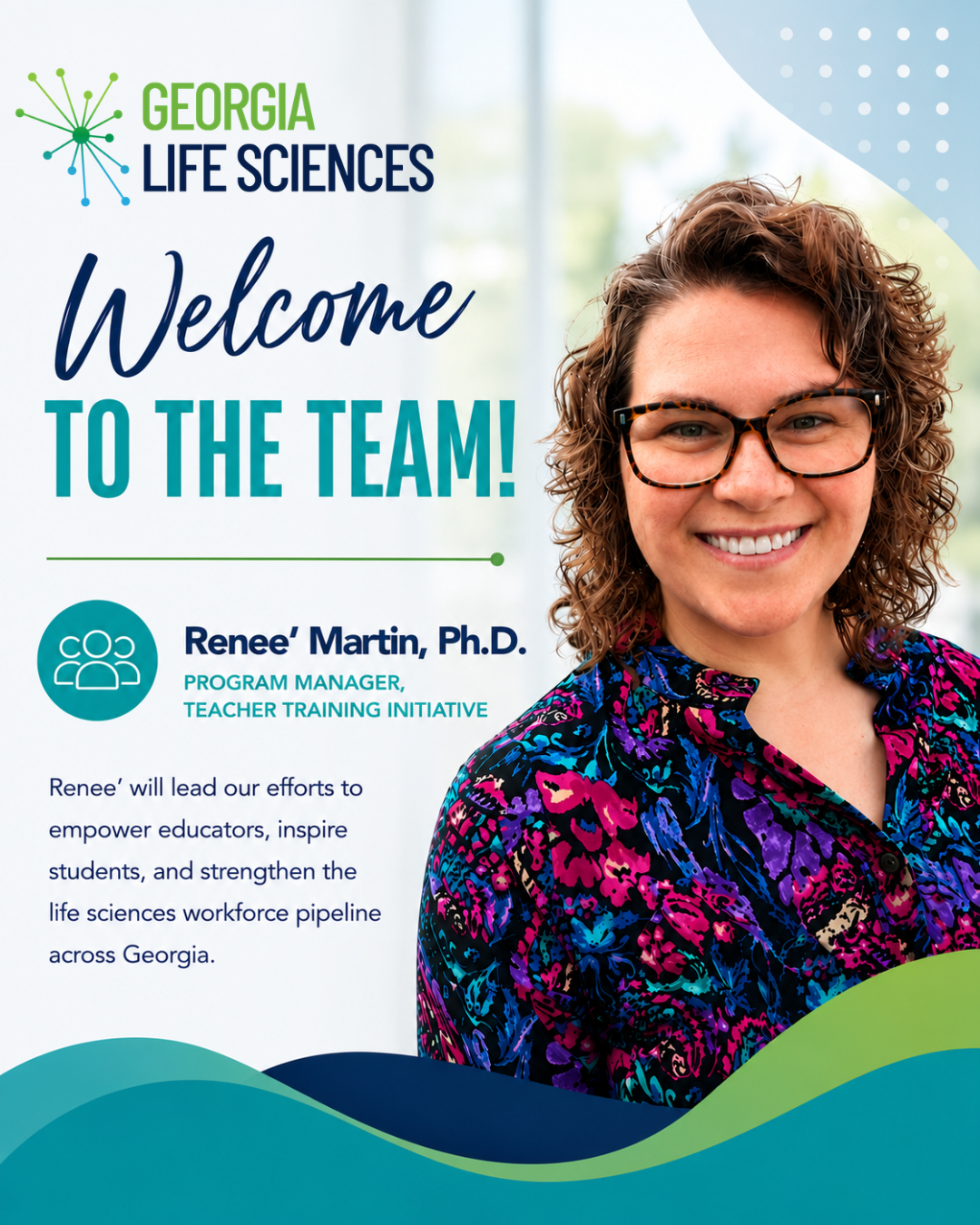
July 21, 2026 (ATLANTA, Ga) – Georgia Life Sciences (GLS) has named Renee' Martin, Ph.D. as Program Manager for its Teacher Training Initiative, one of the state's most established educator workforce development programs designed to prepare middle and high school teachers to introduce students to careers across Georgia's growing life sciences industry.


Now entering its eighth year, the initiative has trained 959 educators who have collectively reached nearly 300,000 students across Georgia. Approximately 70% of participating teachers serve Title I schools, helping expand access to high-quality life sciences education and career exploration in communities throughout the state.


In her new role, Martin will lead the Teacher Training Initiative, a longstanding partnership with the Georgia Department of Education that equips educators with industry knowledge, classroom resources, hands-on laboratory experiences, and connections to Georgia's life sciences ecosystem. She will also oversee the Georgia Life Sciences Equipment Depot, which provides donated laboratory equipment and educational resources to classrooms across the state.


"Preparing Georgia's future life sciences workforce begins by investing in our educators," said Maria Thacker Goethe, President & CEO of Georgia Life Sciences. "Renee' brings an exceptional combination of classroom experience, educator leadership, and a deep understanding of Georgia's education system. Her experience supporting teachers across the state, combined with her passion for workforce development, makes her uniquely positioned to lead this important initiative as we continue expanding opportunities that connect educators, students, and Georgia's life sciences ecosystem."


A seasoned educator with a solid track record in agricultural and STEM education, Martin has taught and supported students and teachers across Georgia and most recently served with a Georgia Regional Educational Service Agency (RESA), where she worked with educators to strengthen instructional practices and student outcomes.


She earned her Ph.D. in Agricultural Leadership, Education and Communication from the University of Georgia, where her work focused on agricultural education, educator development, and workforce preparation.


Beyond her professional experience, Martin has demonstrated a strong commitment to leadership and service through numerous roles with the University of Georgia Graduate Student Association, Designated Dawgs, the Association for International Agricultural and Extension Education (AIAEE), and other community and professional organizations.


"I am honored to join Georgia Life Sciences and contribute to a program that is making a meaningful difference for educators and students across Georgia," said Martin. "Teachers play a vital role in helping students discover new opportunities and envision future careers. I look forward to working with educators and industry partners to strengthen those connections and inspire the next generation of Georgia's life sciences workforce."


Martin joins Georgia Life Sciences as the organization continues to expand its statewide workforce development efforts to meet the talent needs of Georgia's rapidly growing life sciences sector. Through educator training, industry partnerships, classroom resources, career awareness initiatives, and the Georgia Life Sciences Equipment Depot, the organization is helping build the skilled workforce that will power Georgia's future economy.


Additional information about the Georgia Life Sciences Teacher Training Initiative is available at www.galifesciences.org.


About Georgia Life Sciences

Georgia Life Sciences is the state's leading life sciences membership organization, representing biotechnology, biopharmaceutical, medical device, diagnostics, research, and life sciences service companies, along with academic institutions and ecosystem partners. Through advocacy, workforce development, and industry engagement, Georgia Life Sciences works to advance innovation, strengthen Georgia's life sciences economy, and develop the talent pipeline that powers the industry's future.


October 15, 2026
As pharmaceutical and biotechnology companies expand U.S. manufacturing operations, a growing demand for specialized talent underscores the importance of industry-driven workforce development. October 16, 2026 | Georgia Life Sciences The United States is experiencing a resurgence in domestic manufacturing investment, with pharmaceutical and biotechnology companies announcing major expansions and new production facilities. But as investment accelerates, a critical challenge is emerging: ensuring that a skilled workforce is available to support this growth. According to a Deloitte and The Manufacturing Institute study , approximately 3.8 million manufacturing positions could need to be filled nationwide through 2033 , with as many as 1.9 million potentially remaining unfilled due to workforce and skills gaps. While these projections span the broader manufacturing sector, the implications for life sciences are significant. Biomanufacturing's Growing Talent Challenge A recent PharmaVoice article examines how pharmaceutical companies are responding to growing competition for skilled workers, particularly in specialized roles such as automation engineering, quality assurance, regulatory affairs, process engineering, and manufacturing operations. These positions are essential to bringing new facilities online, maintaining regulatory compliance, and ensuring safe, reliable production. The challenge extends beyond competition among pharmaceutical manufacturers. Life sciences companies are increasingly competing with industries such as semiconductors, aerospace, energy, and advanced manufacturing for workers with similar technical skills. Some companies are responding by investing directly in regional education and training partnerships. Eli Lilly, for example, recently committed $15 million to San Jacinto College in Texas, including $12.5 million dedicated to workforce training, alongside a major manufacturing expansion in the Houston area. The message is increasingly clear: Workforce planning must begin alongside facility planning, not after construction is complete. What This Means for Georgia Georgia has an opportunity to build on its growing biomanufacturing presence, established industry base, research universities, and technical education infrastructure. However, continued success will depend on ensuring that workforce development keeps pace with industry investment. As manufacturing technologies evolve, employers will need workers with expertise in automation, digital systems, quality control, and advanced production processes. Traditional education pathways alone may not be sufficient to meet these changing needs. That makes stronger collaboration among employers, educational institutions, workforce organizations, and policymakers increasingly important. Through its Manufacturing Council, Georgia Life Sciences is working to strengthen industry engagement and better understand employers' evolving workforce needs. These conversations help identify opportunities to align education and training with the skills companies need today and anticipate those they will require tomorrow. The Georgia Life Sciences Institute also supports the long-term talent pipeline through education and workforce initiatives designed to introduce students and educators to life sciences careers and strengthen connections between education and industry. Looking Ahead: Talent as a Competitive Advantage As states compete to attract life sciences investment, workforce readiness will increasingly influence where companies choose to expand and how successfully those investments translate into long-term economic growth. For Georgia, the opportunity is not simply to attract new facilities but to build the talent ecosystem necessary to sustain them. That requires earlier employer engagement, flexible training models, stronger industry-education partnerships, and continued attention to emerging technologies that are changing the nature of manufacturing work. The next chapter of biomanufacturing growth will be defined not only by where companies invest, but by where they can find, develop, and retain the talent needed to succeed. Related Reading Deloitte: Taking Charge — Manufacturers Support Growth With Active Workforce Strategies PharmaVoice: Pharma's Manufacturing Boom Has a Workforce Problem
October 5, 2026
Georgia Life Sciences has submitted written comments to the Georgia House Study Committee on Pharmacy Benefits Managers and Consumers’ Access to Prescription Medications, encouraging greater transparency, accountability, and a focus on measurable patient benefit across the prescription drug system. The comments address both pharmacy benefit manager practices and the federal 340B Drug Pricing Program, emphasizing the importance of understanding where prescription drug savings accrue and whether those savings ultimately benefit patients. The Study Committee continues its work this fall as it develops recommendations for the Georgia General Assembly. Read Georgia Life Sciences’ full comments →
September 22, 2026
Georgia Life Sciences (GLS) has joined more than 80 organizations from across industry, academia, public health and the biosecurity community in calling on congressional leaders to fully reauthorize the Pandemic and All-Hazards Preparedness Act (PAHPA) before the end of 2026. Led by the Johns Hopkins Center for Health Security, the coalition urged congressional leaders to advance a comprehensive reauthorization of PAHPA, the federal framework that supports the nation’s ability to prepare for and respond to public health emergencies and other health security threats. First enacted in 2006, PAHPA established and strengthened critical components of the nation’s health security infrastructure, including the Biomedical Advanced Research and Development Authority (BARDA). The law also supports public-private partnerships involved in the research, development, manufacturing and procurement of medical countermeasures, including vaccines, therapeutics and diagnostics. PAHPA’s authorization expired in 2023 and key provisions have since continued through short-term extensions. The coalition is calling for a comprehensive reauthorization that provides greater stability and ensures the nation’s preparedness infrastructure can continue adapting to emerging biological, infectious disease and other health security threats. For the life sciences industry, these programs are particularly important. Partnerships between government and industry can help move promising technologies from research through development and manufacturing while maintaining capabilities needed to respond quickly during an emergency. The Biotechnology Innovation Organization (BIO), also a signatory to the letter, has identified several priorities for reauthorization, including continued authorization of BARDA, the Strategic National Stockpile, Project BioShield and the Pandemic Influenza Program, as well as incentives supporting the development of medical countermeasures. Georgia Life Sciences is proud to join organizations across the country in supporting a strong and sustainable national framework for health security, preparedness and biomedical innovation. Read the coalition letter and view the full list of signatories.
MORE POSTS