Georgia Strengthens Life Sciences Workforce Pipeline with Continued Investment in Biotech Education
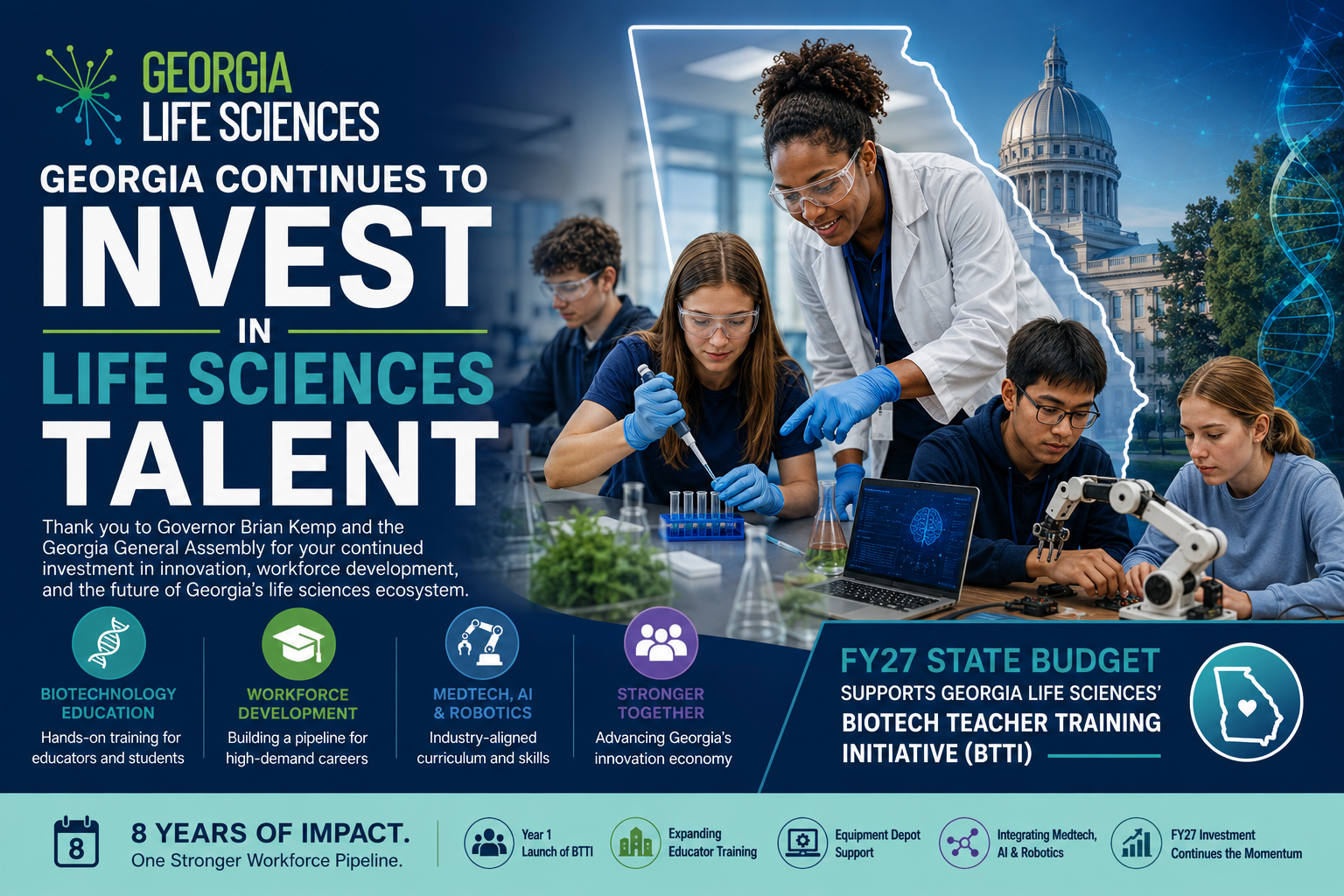
May 29, 2026 - Georgia Life Sciences is grateful to Governor Brian Kemp and the Georgia General Assembly for their continued investment in innovation, workforce development, and the future of Georgia’s life sciences ecosystem through the FY27 state budget. 


This funding, now in its 8th year, will support the continued growth of Georgia Life Sciences’ Biotech Teacher Training Initiative (BTTI) and strengthen our mission to build a world-class life sciences workforce pipeline across the state. By equipping educators with hands-on biotechnology and medtech training, industry-aligned curriculum (integrating medtech/AI/robotics), and real-world learning experiences, we are helping prepare students for high-demand careers in Georgia’s rapidly growing life sciences sector. 

Georgia continues to demonstrate national leadership by investing in the infrastructure, talent, and partnerships needed to drive scientific innovation, economic growth, and improved health outcomes. We appreciate the support of Governor Kemp and members of the General Assembly who recognize the critical role the life sciences industry plays in Georgia’s economy and future competitiveness.

July 13, 2026
BioMADE Releases New National Survey Showing Strong, Bipartisan Support for U.S. Leadership in Bioindustrial Manufacturing 
July 13, 2026
From global biopharmaceutical executives and venture capital leaders to AI innovators, manufacturing experts, and policy influencers, this year's Georgia Life Sciences Summit (August 25-26) brings together the voices shaping what's next in biotechnology, medical technology, and life sciences manufacturing. Industry Visionaries Tim Opler, Stifle (Keynote), CEO Spotlights from Moonlight Therapeutics, Nephrodite, Nutriband, Nyra Medical Innovation & AI Pfizer, Roche Diagnostics, Zifo Investment & Capital Ascenta Capital, NovaQuest Capital Management, Solas BioVentures Manufacturing & Supply Chain Bend Biosciences, Micron Biomedical, Remington Medical, Vitrian, The Risk Project Research & Commercialization Emory University, Shriners Children's Research Institute, Biolocity Policy & Advocacy Incubate Coalition, Greenberg Traurig Whether you're building the next breakthrough therapy, scaling manufacturing, raising capital, or navigating today's policy landscape, you'll hear directly from the executives and innovators leading these conversations every day. Join the leaders shaping the future of life sciences 
July 8, 2026
Wednesday, July 8, 2026 - Georgia Life Sciences is encouraged by the recent federal court decision issuing a preliminary injunction that prevents Colorado from implementing its upper payment limit for Amgen’s Enbrel, a patented treatment for rheumatoid arthritis and other autoimmune conditions. The ruling underscores a critical concern for the life sciences sector: state-level price controls, particularly those applied to patented medicines, raise significant legal questions and can create uncertainty for the innovation ecosystem that supports the development of new treatments. Colorado’s Prescription Drug Affordability Board had sought to impose the nation’s first upper payment limit on a specific prescription medicine. While the goal of improving affordability for patients is important and shared across the healthcare ecosystem, government-set price caps are the wrong approach. They risk undermining investment in biomedical innovation without guaranteeing that savings will reach patients at the pharmacy counter. As more states consider Prescription Drug Affordability Boards with authority to impose upper payment limits, policymakers should proceed with caution. These boards can add costly and complex layers of bureaucracy while creating uncertainty for companies working to discover, develop, manufacture, and deliver new therapies. To date, PDABs have not demonstrated that they meaningfully lower out-of-pocket costs for patients. GLS supports policies that improve affordability and access in ways that directly benefit patients. Rather than pursuing government-set price controls, policymakers should focus on reforms that address the real drivers of patient costs, including ensuring manufacturer rebates are passed through to patients, increasing transparency across the drug supply chain, promoting competition through generics and biosimilars, and expanding affordable insurance coverage. Patients need solutions that lower costs where they feel them most, at the pharmacy counter. Georgia Life Sciences will continue to advocate for patient-focused policies that improve access, preserve innovation, and support a strong life sciences ecosystem. Source: The court blocked Colorado’s first-in-the-nation Enbrel UPL through a preliminary injunction, with the cap set to take effect in January 2027. More here: https://www.reuters.com/legal/litigation/judge-blocks-colorados-first-of-its-kind-price-cap-amgens-enbrel-2026-07-01/
MORE POSTS